_edited_edited_ed.png)
Federal Court Blocks the “Duration of Status” Rule of Four-Year Cap on Student Visas Before It Could Take Effect
A federal court has temporarily blocked the DHS rule that would have replaced "Duration of Status" admission with fixed periods for international students, exchange visitors, and foreign media representatives. The rule was scheduled to take effect September 15, 2026. On September 14, one day before that date, a district court in Massachusetts issued a nationwide preliminary injunction barring DHS from implementing it, meaning that, for now, F, J, and I nonimmigrants across the country keep the duration-of-status framework they have had all along. For students and their families, it's a reprieve, but a provisional one, and it's worth being precise about what the court did.

What the Court Decided
On September 14, District Judge F. Dennis Saylor IV issued an order postponing the rule's effective date. The immediate effect is that DHS cannot put the fixed-admission rule into force for the time being, so the September 15 switch from duration of status to fixed periods simply did not happen.
Notably, the judge made the relief nationwide rather than limiting it to the roughly 600 institutions represented by the plaintiffs. With more than 5,000 colleges and universities in the country, he reasoned that a plaintiff-only order would create parallel regulatory regimes and invite the confusion that would follow when students transfer between covered and non-covered schools or pursue joint degrees, so the pause applies everywhere.
What matters most here is the kind of ruling this is. The court paused the rule's effective date while the litigation continued, but it did not strike the rule down or issue a final judgment against it. The judge observed that fully vacating the rule "may ultimately prove to be appropriate," yet chose the more cautious step of postponement for now, and he denied the plaintiffs' broader requests without prejudice so that they can be raised again later. In short, this is a hold rather than a resolution, and the underlying legal fight remains very much open.
A Refresher on What the Rule Proposed
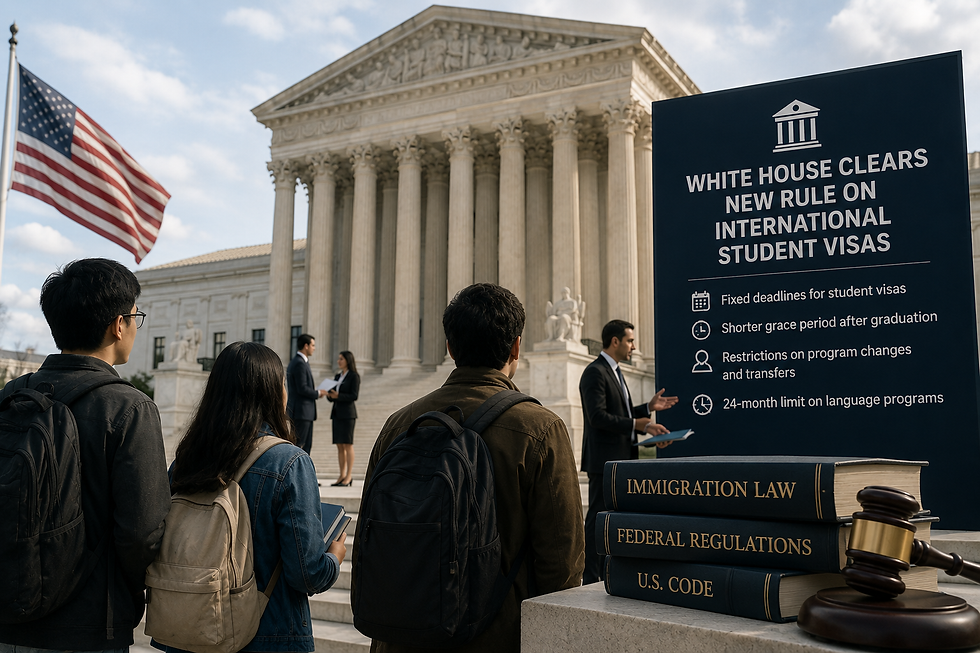
For context, the rule would end the long-standing "duration of status" system, under which F-1 students, J-1 exchange visitors, and I-category media representatives are admitted for the length of their program rather than to a fixed calendar date. In its place it would set fixed admission periods, capped at four years for F-1 students and J-1 exchange visitors and at 240 days for foreign media representatives, and it would require anyone needing more time to apply for an extension of stay or leave and re-enter the country. The rule also layers on a set of academic restrictions for F-1 students, limiting their ability to enroll in a new program at the same or a lower level, change majors or education levels, or transfer schools.
The coalition challenging the rule argues that DHS violated the Administrative Procedure Act by rushing the comment period, failing to weigh the rule's costs and benefits, and brushing past the public comments it received, and that the rule is arbitrary and capricious and exceeds the agency's authority. DHS, for its part, has defended it as a national security and program-integrity measure. In pausing the rule, the court found the challengers likely to succeed on those claims, faulting DHS for not calculating costs, not considering alternatives, not responding adequately to comments, and not connecting the rule to its stated goals of preventing fraud and protecting national security. That is a preliminary assessment offered to justify the pause, not a final ruling that the challengers will win.
What This Means Right Now
For students and exchange visitors, the immediate takeaway is that nothing changes on September 15; duration of status remains in effect nationwide, and there is no need to file an extension application simply because of the rule, or to treat the four-year cap as operative. Affected individuals should coordinate with their designated school official or exchange-program responsible officer before taking any step prompted by the ruling.
Two cautions are worth keeping in mind. First, the injunction does not restore a status that has already ended or extend an expired work authorization, so existing obligations still apply, including maintaining a full course of study, keeping program records current, and observing employment restrictions. Permission to remain and to work are still judged separately, and the pause is not itself an extension of any work authorization.
Second, this is not the last word. The government may appeal, and the court has set a status conference for early October, which is a hearing date rather than the point at which the pause expires. Because an appellate court could intervene, or DHS could move to implement the rule quickly if the order is lifted, students and employers should be ready for the situation to shift again with little notice.
What Employers and Institutions Should Do
For universities, exchange sponsors, and employers, the sensible next step is to walk back any messaging that treats September 15 implementation as certain, and to make sure international offices, HR teams, and immigration counsel are working from the same understanding of where things now stand. Any transition preparations already underway are worth keeping rather than discarding, since the rule could still take effect depending on how the litigation and any appeal play out, but the steps taken specifically for the September 15 cutover should be paused until the operative rules and any further agency guidance are confirmed.
Final Thoughts
The court's decision to pause the rule is a meaningful development, though it remains a temporary one. For now the rule is on hold rather than overturned, and the government may still appeal, so what happens next will depend on how the litigation and DHS's own next steps unfold. In the meantime, anyone holding an affected visa should treat the situation as unsettled rather than resolved, keep an eye out for further court orders and agency guidance, and confirm the operative rules before making any filing or travel decision. If this year's immigration developments have offered one consistent lesson, it is that the ground can shift with little warning, and that it pays to check where things actually stand before acting on them.
Because your Green Card Shouldn't Take a Lifetime


Comments