_edited_edited_ed.png)
Two DHS Final Rules in July 2026: Fixed Terms for Student Visas and a Broader Public Charge Standard
Within the same week, the Department of Homeland Security announced 2 final rules that reshape parts of the U.S. immigration landscape. The first sets fixed periods of admission for foreign students, exchange visitors, and media representatives, ending a decades-old framework that allowed those visa holders to remain for an unspecified duration. The second rescinds the 2022 public charge regulation and restores a broader standard for assessing whether an applicant is likely to become dependent on public benefits. The two rules address different populations and take effect on different timelines, but together they signal a more restrictive and more actively monitored posture toward legal immigration.

Fixed Periods of Admission for F, J, and I Visa Holders
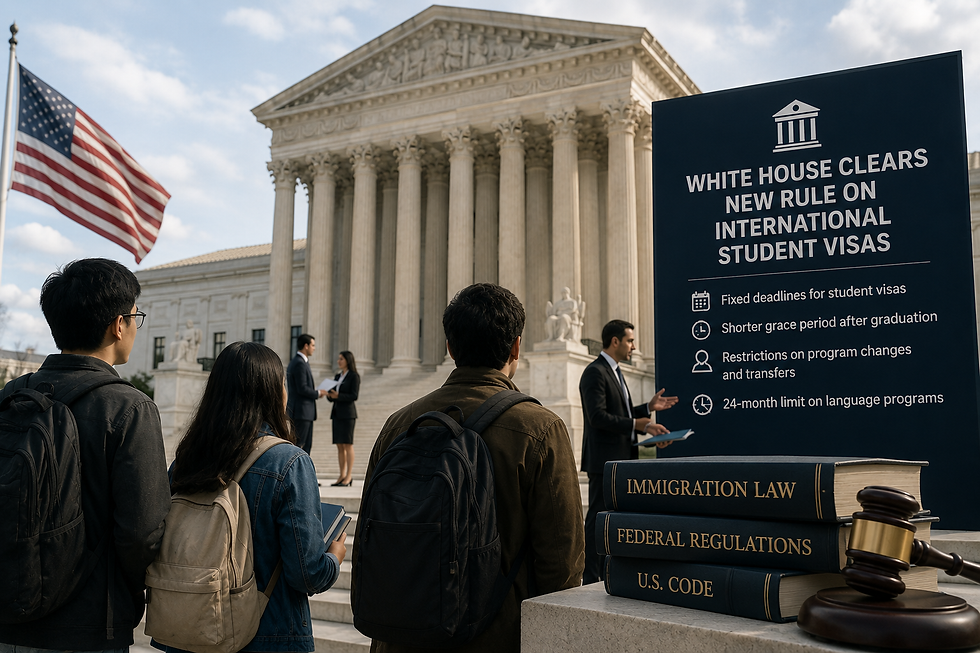
For nearly 5 decades, foreign students and certain other nonimmigrants have been admitted under a framework known as "duration of status," which permitted them to remain in the US for as long as they maintained their program rather than until a specific end date. The new final rule ends that framework for the F (academic student), J (exchange visitor), and I (media representative) classifications, replacing it with a fixed period of admission of the kind already applied to many other nonimmigrant categories.
The core changes are as follows:
A maximum admission period. Students on F visas and J visas will be admitted for the length of their specific program, subject to a maximum of 4 years. Admission is no longer open-ended.
Federal review for extensions. A visa holder who needs additional time to complete an academic program must now formally apply for an Extension of Stay directly with USCIS. Under the prior system, continued enrollment was largely tracked at the institutional level. The rule now shifts that oversight back to the federal government and subjects extension applicants to biometric collection, background checks, and fraud screening.
A shorter departure window. The grace period for F-1 students to prepare to depart, transfer schools, or change status after completing a program is reduced from 60 days to 30 days.
Limits on program changes. The rule introduces restrictions on changing academic programs, though the specific parameters will be defined in the regulation itself.
The rule is scheduled to publish in the Federal Register within days of the announcement and will take effect 60 days after publication. Individuals already in the United States under the previous duration-of-status framework will transition to the new system automatically, with their authorized stay capped at a maximum of four years from the rule's effective date.
This development is also relevant to a segment of the EB-5 audience specifically. International students and their families sometimes explore permanent residence options as their time in the US lengthens, and a framework that imposes firmer limits and additional federal checkpoints on student status is one of the factors that leads some of them to consider a path not tied to program enrollment or employer sponsorship. For a student or family already weighing longer-term options, the shift toward fixed terms is a reason to begin that analysis earlier rather than later.
A Broader Public Charge Standard
The second rule changes how the government decides whether a green card applicant might end up relying on public benefits. This is known as the "public charge" test, and it is not new. Under the Immigration and Nationality Act, someone applying for a visa, admission, or a green card can be denied if officials believe they are likely to become mainly dependent on government support at any point. What changes over time is how strictly that judgment is made.
The 2022 rule narrowed the picture. It limited which public benefits officials were allowed to consider. The new rule removes those limits and lets USCIS officers look at a wider range of factors, case by case, when deciding whether someone is likely to become a public charge. Based on reporting on the rule, the benefits that can now be weighed include things like food assistance, Medicaid, and housing vouchers.
The rule takes effect on September 18, 2026. Alongside it, USCIS will release an updated Form I-485, the application used to apply for a green card from inside the US. This matters for timing: older versions of the form will not be accepted if they are submitted on or after that date. Anyone planning to file around then should make sure they are using the current version and plan their filing date accordingly.
DHS describes the change as a way to reinforce self-reliance and protect public resources. The approach was first used in 2020, then reversed, and is now back, and its return has drawn criticism too. Advocacy groups have called broad public charge tests a kind of "wealth test," and public health experts have warned that such rules can scare immigrants and their U.S.-citizen family members away from using benefits they are legally allowed to have, for fear it could hurt their immigration case. Both sides of that debate are part of the public record, and the useful thing for readers is to understand the actual standard rather than the arguments around it.
Practical Takeaways
The two rules affect different groups, but a few common threads are worth noting. Both move oversight and discretion toward the federal government and away from more permissive prior frameworks, and both are best approached with attention to timing. For student and exchange visitor populations, admission now carries a hard limit and extensions require federal filings, which rewards early planning for anyone whose program or intended stay extends beyond four years. For prospective permanent residents, the broader public charge standard and the accompanying new I-485 form make filing dates and form versions matter more than they did.
For those already pursuing or considering EB-5, neither rule alters the core of the program, and the investment-based nature of the category positions EB-5 applicants comparatively well under the restored public charge standard. What the developments underscore is a broader environment in which timing, documentation, and professional coordination carry increasing weight across immigration pathways.
Because your Green Card Shouldn't Take a Lifetime


Comments