_edited_edited_ed.png)
The White House Clears Rule Imposing Fixed Deadlines on International Student Visas
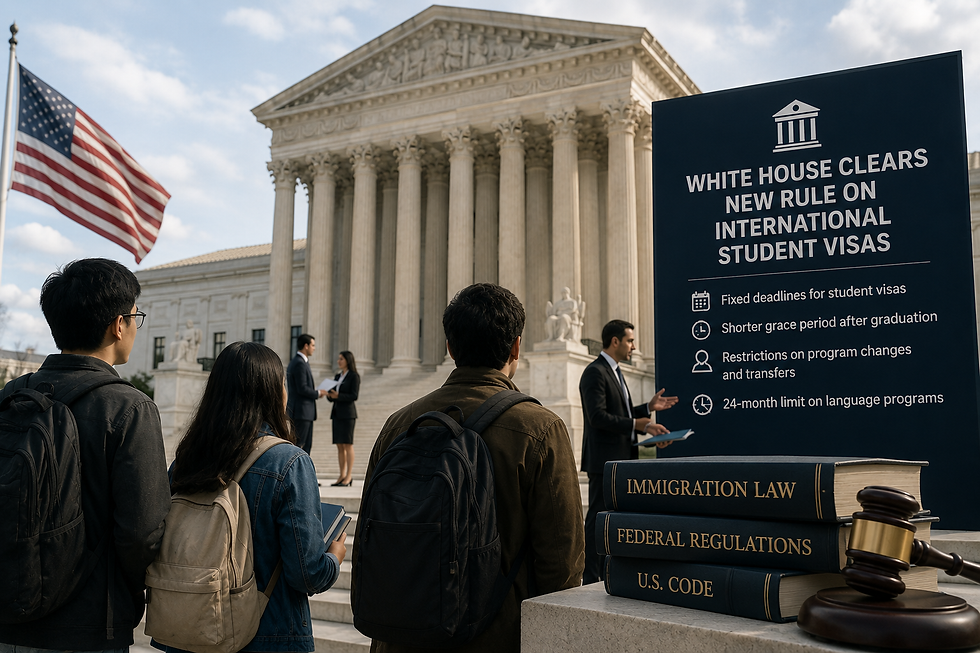
The White House just cleared a major immigration rule that would change how long international students can stay in the United States. And for hundreds of thousands of students already here, the clock is about to get a lot more concrete.
The rule was cleared by the Office of Management and Budget on June 17, 2026. It can be published in the Federal Register at any time. Once published, it takes effect 60 days later and it would apply to F visa holders, J exchange visitors, I visa holders and their dependants.
What Is Changing for International Students
Fixed time period for Form I-94
Under the current system, international students on F-1 visas don't have a fixed expiration date on their authorized stay. Their Form I-94 simply reads "D/S," short for Duration of Status. That means students can stay as long as they're enrolled, maintaining academic progress, and keeping up their status. No hard deadline, no renewal clock ticking in the background.
The new rule ends that. Going forward, students would receive a specific end date tied to their program length, capped at four years. For students in shorter programs, that cap won't matter much. But for PhD students and long-term researchers (many of whom routinely take five, six, or seven years to complete their degrees), this is a significant shift. Once that four-year window closes, they'd need to file a formal Extension of Stay application with USCIS, pay the associated government fees, and wait for approval. That process currently happens through the university; but under the new rule, it goes through the federal government.
Shorten F-1 grace period after graduation
The grace period after graduation also gets shorter. Right now, F-1 students have 60 days after completing their program to apply for OPT, switching immigration status, or preparing to leave the country. This new rule cuts that window down to 30 days. For students navigating post-graduation job offers, OPT paperwork, or change-of-status applications, that means a huge reduction in time.
Other changes implemented
Flexibility around changing academic programs also gets tightened considerably. Under the new rule, undergraduate students wouldn't be allowed to change their major or transfer to a different university during their first year in the US. For graduate students, the restriction goes further. They couldn't change their educational objective or transfer schools at any point during their studies. In research fields where switching advisors or departments is a routine part of doctoral work, this could create real complications.
On top of that, students who have already completed a degree at one level—say, a bachelor's—would no longer be permitted to return to study at that same or a lower level while on an F-1 visa. Lastly, the rule also places a 24-month lifetime cap on English language training programs, ending the option of extended stays for language students.
Why the Government Is Doing This
The Department of Homeland Security has framed this as a program integrity and national security issue. Without fixed end dates, DHS argues it's difficult to know when a student has actually fallen out of status, which makes enforcement harder and creates gaps that can be exploited. Officials have cited documented fraud cases, including "pay-to-stay" schemes where school administrators allegedly accepted payments to falsely certify that non-attending students were maintaining enrollment. There are also cases on record of individuals remaining in the US on active F-1 status for over two decades, which DHS says is well outside the intent of a visa designed for temporary study.
It's worth noting this isn't a brand new idea. The same rule was proposed during the first Trump administration in 2020, then pulled by the Biden administration in 2021. The rule is now back and this time, it's cleared every regulatory hurdle.
Who Is Affected the Most
India sends the largest number of international students to the US, with close to 360,000 enrolled as of the latest data. A significant share of those students are in extended doctoral and research programs that routinely run longer than four years. For them, the new rule means navigating federal extension applications mid-program, which adds cost, paperwork, and uncertainty at exactly the moment they should be focused on finishing their work.
The restrictions on switching programs or transferring universities also hit graduate students particularly hard. In research-heavy fields, changing advisors or departments is sometimes a normal and necessary part of completing a degree. That kind of flexibility disappears under this rule.
It is worth noting that a bipartisan group of lawmakers has pushed back, warning that adding these hurdles risks discouraging top international talent from choosing US institutions. Survey data cited by opponents found that nearly half of international graduate students said the rule would make them less likely to study in the United States.
What Happens Next
The rule is cleared. Publication is imminent. International students and universities are now watching for the final text, which will confirm exactly how the rule will be implemented and what transition provisions exist for students already enrolled.
If you're currently on an F-1 visa, or planning to start a program in the US soon, this is the moment to get ahead of the timeline with your university's international student office.
What This Means If You're Thinking Longer-Term
For students who have spent years in the US building careers, this rule is another reminder of how much depends on a visa status that was never designed for permanence. The F-1 was built for temporary study. The rules around it are tightening. And for those thinking seriously about what a stable, long-term future in the US actually looks like, the question worth asking isn't how to extend another temporary status. It's how to stop depending on one entirely.
That's the conversation EB-5 investors are having. The EB-5 program offers a direct path to a US Green Card for you and your immediate family through a qualifying investment in a US project. It doesn't hinge on employer sponsorship, enrollment status, or whether a policy change clears a regulatory review. It's a path you control on your own timeline.
If you've been watching changes like this one and wondering whether there's a more permanent answer, we'd be glad to walk you through what EB-5 looks like for your situation.
Because your Green Card Shouldn't Take a Lifetime


Comments